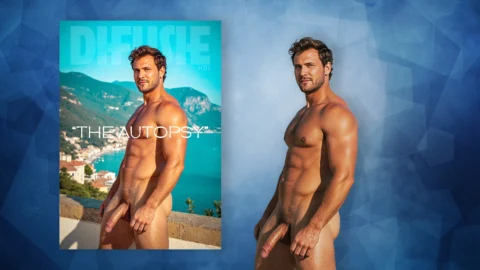
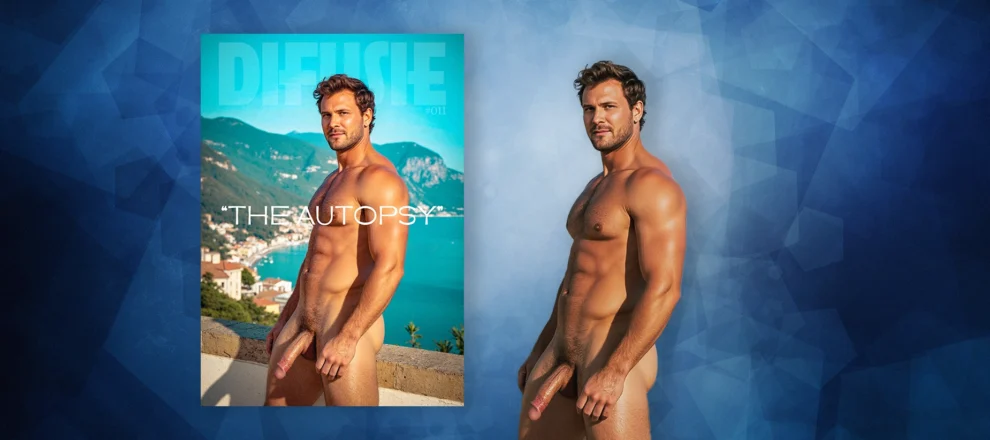
Photography: Yuri Sokolov & Elena van Gallen
Interview & Story: Elena Volk
Subject: Trip Hasard
Setting: A soundproofed viewing room in the DIFUSIE archives, walls lined with lightboxes displaying contact sheets from the “Autopsy” shoot.
[The room is cold. Trip Hasard sits in a steel chair, facing a wall of his own image—a grid of 200 identical frames of his face, neutral, from the Los Angeles studio session. He does not look at them. He looks at me.]
Elena Volk (EV): The title of this issue is “The Autopsy.” Not a portrait. Not a study. An autopsy. When you heard that word, what did you think they were going to cut open?
Trip Hasard (TH): (A slow exhale, smoke-less in the sterile air.) The persona. The performance. The “Trip Hasard” that exists between the last click of the shutter and the first click of the keyboard when someone writes a caption. They wanted to remove the… social tissue. To get to the bare skeleton of what it means to be seen. Not admired. Seen. Like a problem on a slab.
EV: The three acts—clinic, conflict, surrender. In Amalfi, with the rocks cutting into your back, was that pain a performance or a purification?
TH: It was data. (He shifts, as if still feeling the stone.) You can’t act adrenaline. You can’t act the way your body seizes when cold water hits a certain point on your spine. Mira [Trocky] would come in and paint on more “struggle,” more “effort,” but the base layer was just… biological truth. They created a circumstance, and my body filed a report. The bruises were the receipt.
EV: And the receipt was stamped in the Maldives. The “surrender.” It reads as peaceful in the images, but your eyes in those frames are… empty.
TH: Empty is the wrong word. Decommissioned. The fight was over. The interrogation was complete. Floating in that saltwater, I wasn’t a model anymore. I was just a mass. A collection of cells that had been photographed from every possible angle, in every possible state of tension. The surrender wasn’t to the water. It was to the process. I had given them everything. There was nothing left to defend.
EV: Let’s address the central, unignorable fact of these images. Your physicality—specifically, your endowment—is not implied; it is central, documented with a forensic focus. Is that the core specimen being dissected?
TH: (Leans forward, his gaze finally locking onto the grid of his own face.) It is the evidence. It’s the fact that provokes the reaction. The autopsy isn’t on it. The autopsy is on everything around it. The gaze, the assumption, the power, the curiosity, the envy, the dismissal. They isolate the most commented-on part of the physical fact of me, and by shining that relentless, clinical light on it, they force a conversation about everything but the flesh. The flesh is just the catalyst. The reaction is what’s being studied.
EV: You’ve spoken before about the “ghost” you resemble. In this Autopsy, did you feel you were finally dissecting that ghost, or were you dissecting the man who had to carry it?
TH: I was dissecting the space between them. The ghost is a story people tell. The man is a story I tell. In that studio, under those lights, all the stories stopped. There was no narrative. There was just… measurement. They calipered my reality. For once, it had nothing to do with anyone else’s fiction.
EV: The final image in the book is a tight shot from the Maldives, water droplets on skin, completely still. What is the conclusion of the report?
TH: (A long silence. He looks at the wall of his face, then back to me.) The conclusion is that the specimen survived. The body endured. But the subject… the conscious “I” that walked into the studio… that was neutralized. What walked out was just… evidence of its own existence. I am no longer a person. I am a precedent.
EV: Is that freedom, or a life sentence?
TH: (He stands, the chair scraping loudly in the quiet room.) It’s the verdict. The sentence is whatever you decide to do with it. Now, if you’ll excuse me, I have to go be a person again. It’s exhausting work.
[He leaves. The door shuts with a soft click. On the wall, 200 versions of Trip Hasard stare out, forever frozen in the moment before the first incision.]
– END TRANSCRIPT –
*This conversation is extracted from the 110-page interview within DIFUSIE Magazine Issue 011: “TRIP HASARD — THE AUTOPSY,” available as a limited edition folio.*