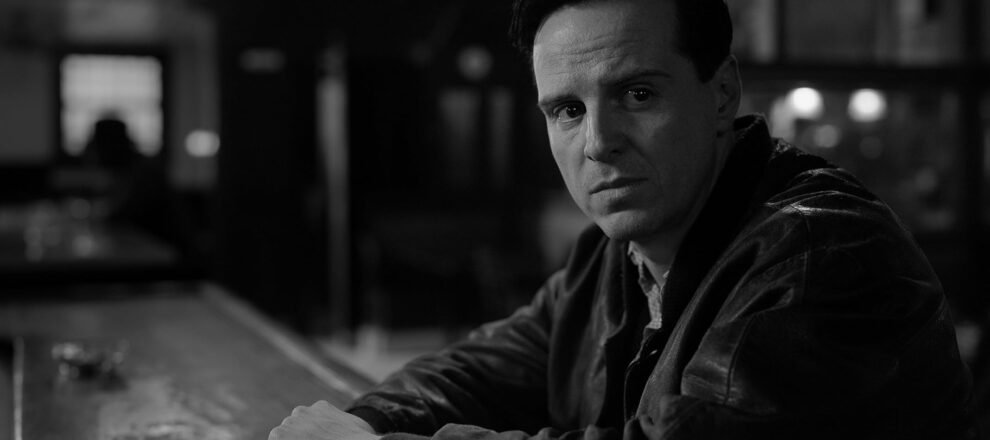
Netflix’s 2024 mini-series Ripley, created, written, and directed by Steven Zaillian, is not merely an adaptation of Patricia Highsmith’s seminal 1955 novel The Talented Mr. Ripley. It is a radical and meticulous reinterpretation that eschews the sun-drenched glamour of previous versions (most notably Anthony Minghella’s 1999 film) in favor of a stark, black-and-white, psychological noir. This series is a deliberate and chilling descent into the mind of a sociopath, told through a visual language as calculated and cold as its protagonist.
Thesis: A Noir Reimagining
The most immediate and defining characteristic of Ripley is its aesthetic. Zaillian’s decision to film in high-contrast black and white is not a gimmick; it is the central thesis of the entire production. This choice fundamentally recontextualizes the story:
- From Glamour to Grit: The Amalfi Coast is stripped of its postcard-perfect colors. Instead of vibrant blues and yellows, we see harsh sunlight creating deep, consuming shadows, and choppy, ominous grey seas. Italy becomes less a paradise and more a labyrinth of ancient, oppressive stone alleyways and stark, unforgiving landscapes. This visual tone aligns with Tom Ripley’s experience: he is not there to enjoy beauty but to exploit opportunity, and the world reflects his own moral emptiness.
- A Cinematic Homage: The cinematography by Oscar-winner Robert Elswit is deeply indebted to Italian Neorealism and American film noir. The play of light and shadow (chiaroscuro) recalls the paintings of Caravaggio, who is directly referenced in the plot. The compositions—long, empty hallways, silhouettes against windows, faces half-obscured in darkness—evoke the psychological tension of classic noir, where the environment is an active participant in the narrative.
- Focus on Form and Texture: Without color to distract, the viewer becomes hyper-aware of textures: the grain of ancient wood, the smooth coldness of marble, the wet slickness of a boat deck, the gritty dust of an Italian piazza. This tactile quality grounds the story in a tangible, often grim, reality.
Character Analysis: The Hollow Man
- Tom Ripley (Andrew Scott): Scott’s performance is a masterclass in controlled menace and profound emptiness. Unlike the charming, almost sympathetic Ripley of Matt Damon, Scott’s iteration is visibly uncomfortable in his own skin from the very first frame. He is a creature of observation and mimicry, studying the movements and manners of others like a predator learning its prey. His “talents” are not presented as effortless charm but as a desperate, laborious act of survival. Scott conveys volumes through stillness and a chilling, reptilian gaze. His violence is not explosive but clumsy, frantic, and horrifyingly physical, making the murders feel more real and gruesome than any stylized color version could.
- Dickie Greenleaf (Johnny Flynn): Flynn’s Dickie is not a golden god but a petulant, bored, and ultimately shallow trust-fund child. He is entitled, casually cruel, and easily bored. This characterization is crucial because it makes Ripley’s obsession with him—and his life—more pathetic and disturbing. We understand the allure of the wealth and freedom, but Dickie himself is unworthy of the murderous devotion he inspires. His rejection of Tom is born not of moral clarity but of snobbery and annoyance.
- Marge Sherwood (Dakota Fanning): Fanning delivers a sharp, intelligent performance that redefines Marge. She is not a naive, grieving girlfriend but a perceptive and suspicious working woman—a writer. Her wariness of Tom is immediate and professional; she sees him as an intruder and a fraud. This elevates her from a plot device to a genuine antagonist to Ripley’s schemes, making their cat-and-mouse game in the later episodes intensely suspenseful.
- Inspector Ravini (Maurizio Lombardi): The Italian inspector is a superb addition. He is dogged, intelligent, and unassuming. His investigation provides a crucial counterweight to Ripley’s internal world, representing the slow, grinding, but inevitable process of law and order. Their interactions are a battle of wits between a man who understands human emotion and a man who can only simulate it.
Narrative Structure and Pacing: A Deliberate Unfolding
Zaillian uses the eight-episode format not to add superfluous subplots, but to luxuriate in the meticulous details of Ripley’s crimes and deceptions.
- The Weight of Process: The series dedicates immense screen time to the process of being a criminal: the agonizing cleanup of a murder, the methodical forging of signatures, the tedious logistics of moving a body, the constant anxiety of being discovered. This slow, deliberate pacing immerses the viewer in Ripley’s paranoid headspace. We feel the exhausting weight of each lie and the immense effort required to maintain his new identity.
- Internal vs. External: The series is largely devoid of a traditional score, relying on ambient sound—the crash of waves, the echo of footsteps, the deafening silence of an empty room. This soundscape forces us to sit with Ripley’s isolation and listen to the terrifying quiet of his own conscience (or lack thereof).
Thematic Deep Dive: Identity, Art, and Morality
- The Performance of Self: The series relentlessly explores the theme of identity as a construct. Ripley has no core self; he is a series of borrowed affectations and stolen identities. The black-and-white photography reinforces this, suggesting a world without moral color, where everything is a performance for shadows. His skill is not in being someone else, but in convincing others he is not the hollow man he truly is.
- Art and Deception: The recurring presence of Caravaggio is genius. The Baroque painter was himself a violent criminal and a murderer, yet he created works of sublime beauty. Ripley identifies with this duality. He sees art not as a expression of truth but as a masterful deception, a technical skill to be admired irrespective of the artist’s morality. The art in the series becomes a mirror for Ripley’s own life—a beautiful, perfect forgery.
Comparison to Previous Adaptations
The 1999 film The Talented Mr. Ripley is a tragic romance gone wrong. It is lush, emotional, and bathed in the warmth of the sun, making the violence that erupts feel more shocking and tragic. It suggests a world Ripley could have had, a life of love and beauty he was ultimately denied due to his own desires.
The 2024 series Ripley is the antithesis of this. It is a psychological crime thriller. There is no romance, no latent homosexuality presented with warmth. Ripley’s desire for Dickie is a desire for his life—his money, his ease, his identity—not necessarily his body. The series is colder, more intellectual, and far more sinister in its portrayal of a man who is, from the very beginning, a empty vessel waiting to be filled by whatever persona offers him an escape from his miserable existence.
Conclusion: A Masterpiece of Atmosphere and Psychological Depth
Ripley is a bold, uncompromising, and brilliant adaptation. Its stark black-and-white cinematography is not just a style but the very essence of its storytelling. By slowing down the narrative and focusing on the grueling process of deception, Steven Zaillian forces the audience to become complicit in Ripley’s crimes, feeling the paranoia and exhaustion firsthand. Andrew Scott’s mesmerizing, unsettling performance is the dark heart of the series, portraying a Ripley who is more pitiable and terrifying than ever before.
It is a challenging, slow-burn series that rewards patience with immense atmospheric depth and psychological complexity. It stands not as a replacement for previous versions, but as a formidable and distinct work of art—a chilling, beautiful, and deeply haunting portrait of a man who mastered everything about being human except actually being one.