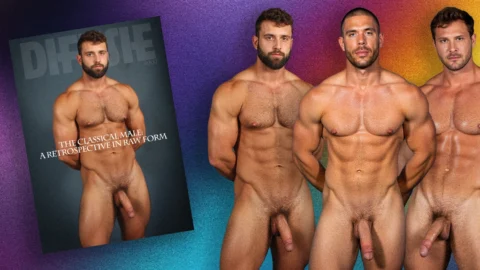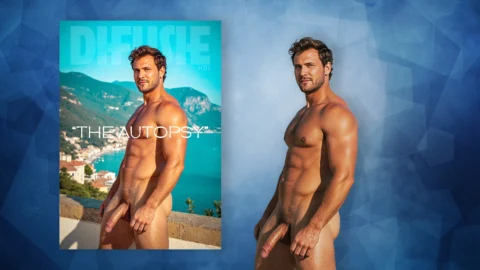
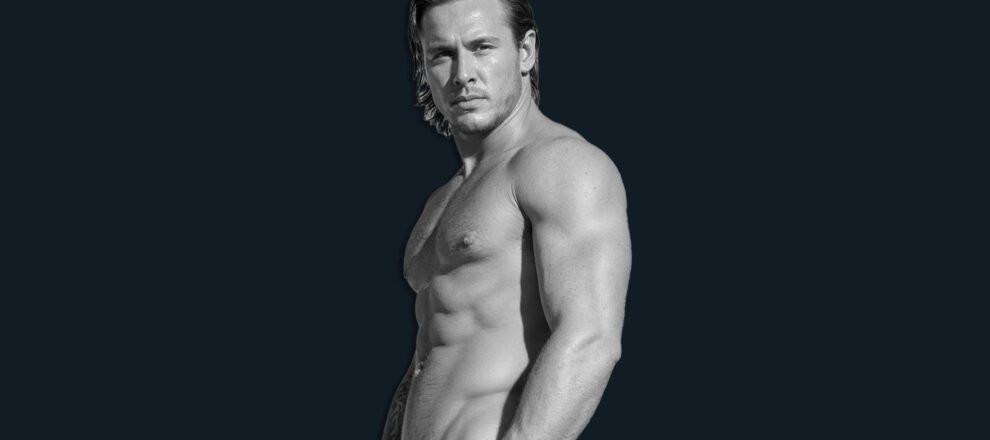
BEYOND THE FRAME: A CONVERSATION WITH TOM GRANT
Photography & Creative Direction: Elena Volk
Subject: Tom Grant
Words: Elena Volk & Tom Grant
(The following interview was conducted over a secure video call. Tom Grant is in his London apartment, the backdrop a curated mess of art books and a large, rain-streaked window. Elena Volk is in her Berlin studio, surrounded by proofs from the 70-page shoot.)
Elena Volk: Tom, thank you for this. Before we even begin to discuss the e-magazine, I have to ask a question that has been with me since the first day of the shoot. When you stepped onto the set, completely stripped of any character, any costume—before we even began—what was the thought in your head? Was it vulnerability? Power?
Tom Grant: (He smiles, a slow, thoughtful unfurling. He leans back, considering the question as if it were a physical object.) Vulnerability and power… they’re not opposites in that space, are they? They’re the same currency. The thought wasn’t a word, Elena. It was a sensation. It was the feeling of the air on my skin, the texture of the concrete floor under my feet. It was about shedding not just clothes, but the Tom Grant that people expect. The model, the producer… all of it. I was just a body in a space, a canvas. And there was an immense power in that surrender. You can’t act when you have nowhere to hide. You can only be.
Elena: That state of ‘being’ is what permeates every single one of the 70 pages. We’ve worked with many incredible subjects, but there’s a raw honesty in this work that is… unprecedented. Even though the e-magazine itself is curated to show a specific vision, the knowledge of that complete nudity, that absolute exposure, informed every moment. Do you feel the audience will sense that?
Tom: I believe so. Authenticity has a frequency. You can try to fake it, but when it’s real, it resonates on a different wavelength. The audience might not know I was naked for that shot against the rusted metal, or the one in the shallow water. But they will feel the truth of it. They’ll feel that there was no barrier between me and the environment, between me and the lens. It’s not about sexuality; it’s about integrity. The photograph becomes a record of a true encounter, not a constructed image.
Elena: Speaking of construction, as a producer yourself, you understand the machinery of image-making. Did that knowledge make it harder or easier to completely relinquish control?
Tom: It was the ultimate test. As a producer, my job is to control variables, to manage the chaos to create a perfect product. This was the antithesis of that. I had to fire the producer in my head. I had to trust you, your eye, the entire team, implicitly. And in doing so, it became the most liberating project of my career. It was a reminder that the most profound art often comes not from control, but from a collaborative, almost sacred, trust.
Elena: The theme of this edition is “The Architecture of Self.” We explored your form as both the subject and the landscape. Were there moments where you felt more like a sculpture than a man?
Tom: Constantly. There was a point, during the session with the sharp, angular shadows, where my body ceased to feel like my body. It became a series of lines, curves, and planes. It was about how the light carved the muscle, how the shadow defined the sinew. I was a material, and you were the architect. It was a deeply meditative, almost out-of-body experience. I wasn’t Tom Grant; I was form and light. It was incredibly peaceful.
Elena: That peace is visible. Even in the most dynamic shots, there’s a profound stillness at your core. Now that this massive, intimate project is out in the world, what do you hope it leaves with people?
Tom: I hope it encourages people to consider their own architecture. To look at their own form, their own essence, with a kinder, more artistic eye. We spend so much time building façades, putting on our own ‘costumes’ for the world. This project was an exercise in demolition. I hope it inspires someone to tear down one wall, to be a little more true, a little more bare—whatever that means for them. It’s not about taking your clothes off; it’s about taking the armor off.
Elena: A perfect note to end on. Tom, it has been the privilege of my career. Thank you for your trust, your artistry, and your breathtaking honesty.
Tom: The trust was mutual, Elena. Thank you for building this incredible architecture with me.