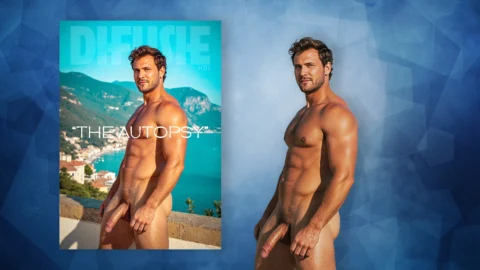
THE SKIN AS A CANVAS: A CONVERSATION WITH COBI LEE
Photography & Creative Direction: Elena Volk
Subject: Cobi Lee
Words: Elena Volk & Cobi Lee
(The interview takes place in a quiet corner of the studio, hours after the final shot. The air still smells of developer and hot lights. Cobi Lee, wrapped in a simple linen robe, sips black coffee. Elena Volk pages through a leather-bound notebook.)
Elena Volk: Cobi, the work we’ve done is… profound. To start, I’d like to go back to the beginning. When we first discussed the concept, and I told you it would require you to be completely unclothed, your response was immediate. You simply said, “Yes, I understand the assignment.” What did you understand it to be?
Cobi Lee: (A calm, knowing smile touches his lips. He places his cup down with deliberate care.) I understood that we weren’t here to create a “nude shoot.” We were here to remove a layer of translation. Clothing tells a story—a specific, designed story. You wanted the story before the costume. The raw material. You weren’t interested in who I am in a tailored suit or streetwear. You were interested in the… the architecture of the self, before the interior decorator arrives. That’s what I said yes to.
Elena: The architecture of the self. I love that. And in that raw state, did you find it difficult to “pose”? The word itself feels wrong now.
Cobi: “Pose” is a performance. This was an act of presence. The most difficult part was the first ten minutes. The mind chatters. Are you standing right? Is this what they want? But then, the chatter stops. You showed me the first Polaroid, the one against the raw silk backdrop. And I saw that it wasn’t about a “pose.” It was about a state of being. The curve of a spine, the tension in a shoulder… they become landscapes. I stopped performing and started… inhabiting.
Elena: You have a background in movement, in dance. How did that discipline inform this process? It’s palpable in the images—a kinetic energy, even in total stillness.
Cobi: Dance taught me that the body is an instrument of expression, not just an object to be viewed. It’s about line, flow, and intention. Here, the movement was microscopic. It was the intake of a breath that lifted the ribcage just so. It was the slight shift of weight that changed the entire narrative of a shadow. My dance training was the grammar, but the language we were speaking was one of pure essence. It was the most subtle, and yet the most demanding, choreography I’ve ever undertaken.
Elena: There’s a specific image, on page 48, where you are dappled in light, almost like a pointillist painting. The expression on your face is one of deep introspection, almost a quiet sorrow. Where does an expression like that come from in such a controlled environment?
Cobi: (He is silent for a long moment, his gaze turning inward.) When you are that open, that vulnerable, the environment doesn’t feel controlled. It feels… collaborative. The light wasn’t just a tool; it was a co-star. In that moment, the warmth of the light on my closed eyelids brought back a memory—a specific, private memory of loss. And because there was no directive to “look happy” or “look strong,” that feeling could just… surface. It wasn’t acted. It was allowed. That’s the trust you gave me. You created a space where my humanity, in all its forms, was welcome.
Elena: That humanity is the core of this entire edition. Now that this work, this incredibly intimate record, is being released to the world, what is your hope for it? What do you want to leave with the person who spends seventy pages with you?
Cobi: I hope it makes them feel less alone in their own skin. We are taught to be so critical of our bodies, to see them as a collection of flaws to be corrected. I hope someone looks at these pages and sees not a “perfect” body, but a human body. A body that contains stories, memories, strength, and fragility. I hope it inspires them to have a quieter, more curious conversation with their own reflection. To see their own skin as a canvas, not for the world’s judgment, but for their own experience.
Elena: A beautiful and profound hope. Cobi, it has been an absolute honor. Thank you for your courage, your artistry, and for building this sacred space with me.
Cobi: The honor was mine, Elena. Thank you for seeing the art in the authentic.