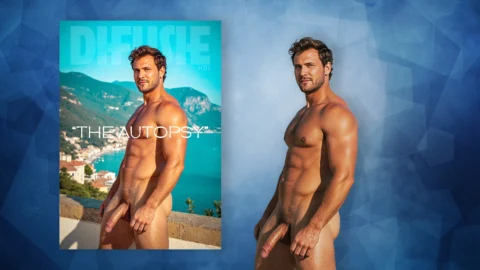
DIFUSIE | BEYOND THE SURFACE
THE MIRROR AND THE MASK: TRIP HASARD’S DANCE WITH ECHOES
Photography: Yuri Sokolov
Producer: Dusan Nikola Ripley
Interview & Story: Elena Volk
(The Hollywood studio is bathed in the pale gold of late afternoon. Trip Hasard stands motionless in a pool of light, his silhouette a study in sharp lines and soft shadows. There’s a practiced stillness to him, a quiet that feels heavy with unspoken narratives.)
Elena Volk: Trip, thank you for being here. There’s an elephant in the room, one I’d like to address immediately. You carry a striking, almost uncanny visual resemblance to a figure from a world that exists in the shadowy corners of the internet. A world you have never been part of. How does it feel to wear a face that is constantly reflecting a ghost?
Trip Hasard: (A slow, deliberate smile that doesn’t quite reach his eyes.) It’s like living in a house of mirrors, Elena. Everywhere I turn, I see a reflection of someone I’m not. At first, it was… unsettling. People would look at me with a flicker of recognition, a whisper. But then I realized—I am not the reflection. I am the light being cast. I began to study that ghost. Not to become him, but to understand the space between us. My work now is about occupying that space.
Elena: And what is that space? How do you define it?
Trip Hasard: It’s the gap between assumption and truth. It’s the chasm where art is born. That man—his image, his notoriety—is a mask society has already made. My work as a model is to show that the same face can wear a thousand different truths. Today, I am not a ghost. I am a poem. I am a ruin. I am a threat. I am sanctuary. The face is just the canvas.
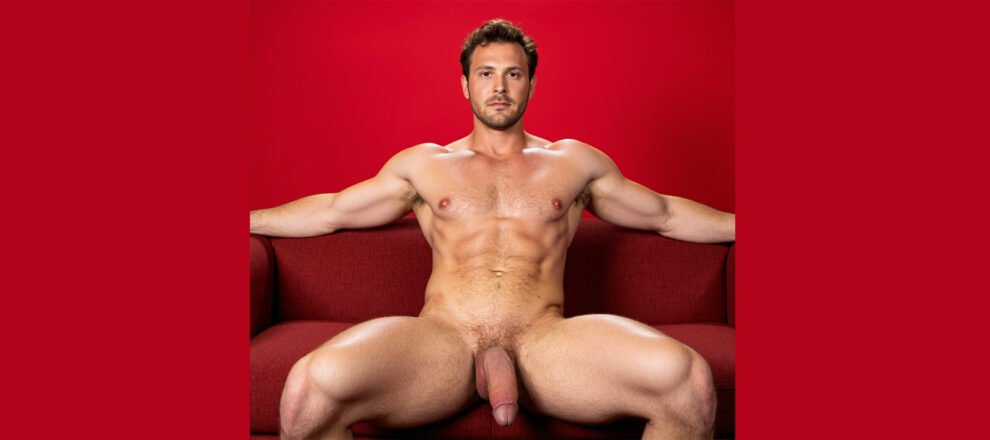
Elena: The photographs Yuri took today are incredibly intimate. There’s one where you’re turned from the camera, the light tracing the line of your spine. It feels like a deliberate turning away from that public perception.
Trip Hasard: Exactly. The most powerful statement you can make is sometimes to turn your back. It denies the viewer the easy consumption of a familiar face. It forces them to look at the architecture, the topography of a body, and to read a new story in it. Yuri understands that. He isn’t photographing my face; he’s photographing my silhouette against the noise of the world.
Elena: Your chosen surname is ‘Hasard.’ Is your career a deliberate gamble, playing with this fire of mistaken identity?
Trip Hasard: Life is the hazard. We are all gambling with the faces we were born with, the assumptions that follow. I’ve just chosen to play my hand with my cards face-up on the table. Yes, it’s a risk. But in that risk, there is immense freedom. By acknowledging the echo, I rob it of its power. I am not running from the ghost; I am using its shadow to give my own form more depth.
Elena: What do you hope to leave the audience with? What is the final impression of Trip Hasard?
Trip Hasard: I want to leave them with a question. I want them to look at these images and ask themselves: ‘How many people have I misunderstood based on a single story? How many faces have I forced to wear a mask they never chose?’ I am not here to erase the ghost. I am here to prove that more than one soul can inhabit a similar vessel. My final impression should be one of beautiful, unsettling ambiguity.
Elena: A perfect note to end on. Trip, thank you for your courage and your profound artistry.
Trip Hasard: Thank you, Elena, for looking beyond the reflection.