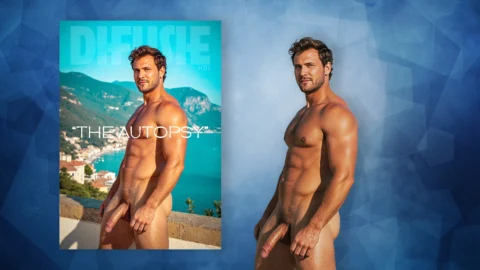

Interview: Deidrich
Photography: Yuri Sokolov & Elena van Gallen
Creative Direction: DIFUSIE Studio
Interviewer: Elena Volk
[The interview takes place on the terrace of a villa in Mykonos, overlooking the Aegean Sea. Deidrich sits in the shade, yet his presence feels like a bedrock. In the distance, the sound of waves.]
Elena Volk (EV): Deidrich. Thank you for this. Your name carries a certain… weight. An old weight. Is that a burden you chose, or one you inherited?
Deidrich (D): (A faint, knowing smile.) A name is a key. It either fits the lock you are, or it doesn’t. Mine fits. I did not choose the weight, Elena. I chose to build a spine strong enough to carry it. The burden is the same for every man: to become equal to his own potential. My name just reminds me of the scale.
EV: This issue, “Hardcore Heritage,” was shot in extremes of beauty—Mykonos, the Maldives, Amalfi. Yet, the concept speaks of a raw, unguarded legacy. How does that luxury frame the brutality of the theme?
D: (Gestures toward the sea.) The luxury is the ultimate test. Anyone can look strong in a wasteland. But here? The true challenge is to retain your edge amidst perfection. To not be softened by the breeze, the silken water, the blinding white. In the Maldives, floating in that warm, forgiving sea, the fight was to remember the cold. In Amalfi, surrounded by sublime beauty, the discipline was to not become decorative. Luxury doesn’t contradict hardness; it interrogates it. It asks: “Is your strength intrinsic, or does it only exist in opposition to hardship?”
EV: There is an image of you in Amalfi at dusk, your silhouette cut against a cliff face that has stood for millennia. What was the conversation between your form and that ancient stone?
D: It was a negotiation of permanence. The stone has witnessed empires. My body will witness a century, if I am fortunate. The photograph is the point where those two timelines intersect. My posture was not one of defiance, but of alignment. I was not trying to conquer the rock. I was seeking permission to borrow, for a fraction of a second, its timelessness. To make the human form appear not as a fleeting guest, but as a permanent feature.
EV: The core idea is a “gene pool without a lifeguard.” No rescue. Do you believe the masculine essence you embody can only be proven in such unsentimental waters?
D: (A low, resonant laugh.) Sentiment is a buoyancy aid. It keeps you afloat, but it prevents you from learning the depths. Yes. The essence—the raw, genetic truth of capability—only reveals itself when the safety nets are removed. Mykonos, for all its beauty, has riptides. The ocean, no matter how turquoise, does not care if you swim. That indifference is the lifeguard’s absence. It is the condition that separates those who have the heritage in their marrow from those who are merely visiting it. You don’t prove yourself to the world. You prove your lineage to yourself.
EV: After this journey across three paradises, what is the one lesson from this “hardcore heritage” that you take with you?
D: That heritage is not a passive inheritance. It is a active current. You don’t receive it; you must swim in it. And you must swim in its deepest, most unsupervised part. The lesson is that the pool is always there. The question is not about the lifeguard. The question is: what kind of swimmer are you? The kind that stays in the shallows, or the kind who needs the deep end to feel alive?
EV: A powerful final thought. Deidrich, thank you for your profound clarity.
D: The clarity was in the water and the stone. I merely reflected it. Thank you.
[End of transcript]
This conversation is part of DIFUSIE Magazine Issue 014: “Hardcore Heritage: A Gene Pool Without a Lifeguard,” available in limited edition.